"Being an adult is actually my strength": Interview with Deanna Stellato-Dudek
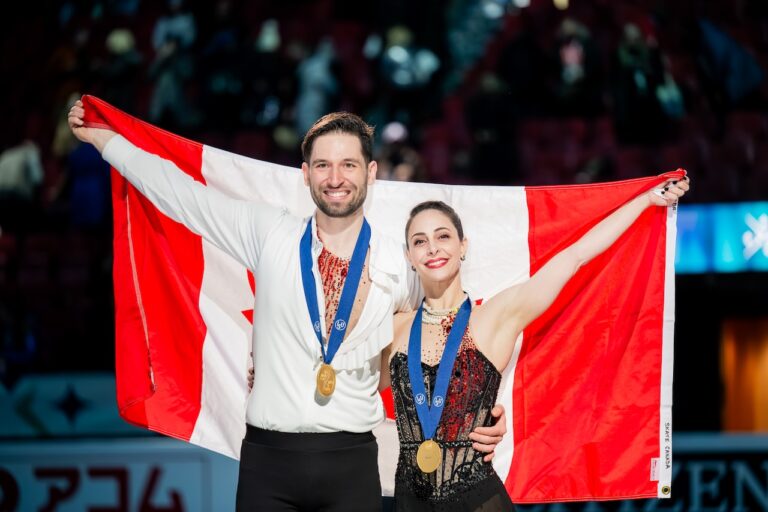
If you think that figure skating is no longer a good idea after age 30, you’re very wrong! Today, we’d like you to meet a woman who has revolutionized skating, leaving us speechless and eager to follow her example.
Deanna Stellato-Dudek is a remarkable case of rebirth in the world of figure skating. Former prodigious talent in women’s figure skating, she achieved excellent results both in the U.S., as in the international circuit, such as winning the Junior Grand Prix and silver at the 2000 Junior World Championships at the age of seventeen. However, due to several injuries, she made the tough decision to retire from competition, pursue her studies, and enter the “normal” working world.
After a 16-year break, at the age of 33, she decided to return to skating, taking on the additional challenge of competing in pair skating. Year after year—first with Nathan Bartholomay, then with her current partner Maxime Deschamps—she quickly climbed the rankings, eventually making her mark on the global scene by winning the gold medal at the 2024 World Championships. And so, at 41, she became the oldest skater in history to win a world title in figure skating
We interviewed her to talk about what it means to start over as an adult, to face judgment from others, to laugh at the stereotypes in our sport, and, above all, to have a lot of fun. To understand that: yes, you too can step onto or return to the ice at any age! Maybe not for the World Championships, but for the pure joy of skating and pushing your limits!
Hi Deanna, when you returned to the ice as an adult, after so many years away from skating, what was your first feeling? Was it more like a homecoming or did you ever think, “What the heck am I doing?” Was there something that surprised you about yourself in your return?
I first came back to skating in 2016 after attending a work retreat with my company. At the retreat we all sat around the lunch table and each person picked up a note card that had a question on it. The question I got was “what would you do if you knew you couldn’t fail.” Without thought I said, “I would win an Olympic gold medal.” That was the catalyst to stepping back on the ice again.
From the first time I laced up my 16-year-old boots and blades, it was with the intention of reigniting this Olympic dream and winning an Olympic gold medal. I felt utter freedom and loved playing my favorite songs while I was skating – it was definitely a homecoming. There is a feeling to skating that cannot be replicated anywhere else in life, the movement, the gliding, artistic expression and the challenge are all so unique in skating. It all felt fantastic to me.
My first day back to skating was at 6 a.m. before work. I purposely drove far away from where I grew up skating so I would not be recognized or asked any questions (I even had blonde hair!), but I was recognized anyway on my first day back, haha! It was for the best though. All the skaters I grew up with are now coaching and cheering me on.
I do remember something funny about when I returned to skating. The first time I started spinning again I got very nauseous. I would drive to work feeling terrible. The nausea lasted for two weeks every time I would spin, and then my body and brain got used to the feeling again.
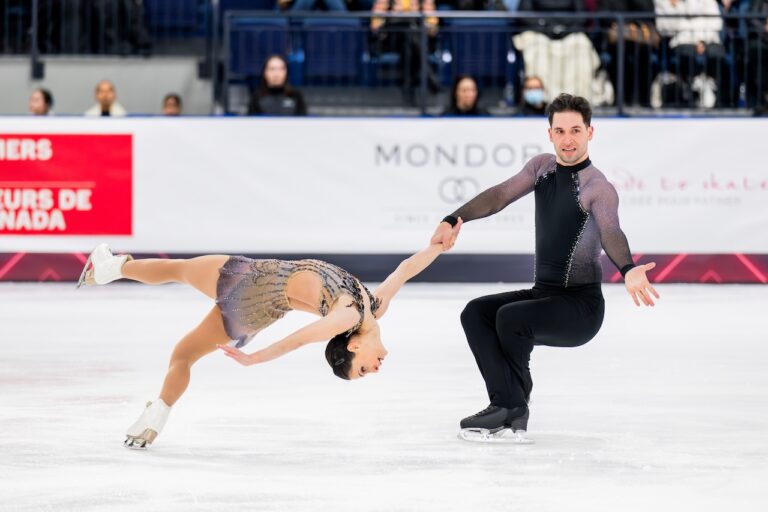
What’s a belief you had at 16 about skating that now, after your journey, you find ridiculous? What makes you laugh the most about the skating world seen from an “adult” perspective?
As a young girl, I thought everyone watched figure skating. I remember leaving for an event and being in an airport, I was upset at the time of our flight because it meant I could not watch a competition on T.V. that day. As we were walking in the airport, I noticed not one restaurant had figure skating on T.V. That’s when I learned that not everyone watches every figure skating event like me.
I always try to remember when I compete that although, for me, it is a big deal because I have sacrificed so much and have worked so hard for this, someone else in another part of the world doesn’t even know what figure skating is and has never had the opportunity to try it. It helps to keep me grounded and to remind me how blessed I am to have these opportunities.
Do you have a pre-competition routine that you never would have followed when you were younger? How has your warm-up and focus method changed? Is there something about how you train, compete, or experience the ice now that would have been impossible at 16?
My pre- and post-training/competition routines are dramatically different than they were when I was 16. At 16, I just came home after practice and ate whatever pasta dish my Italian parents made for me. At 41, I have to warm up longer and I have a three-hour nightly recovery routine. At 16, I spent zero hours recovering! When you are older, you are CHOOSING to be an athlete and are solely responsible for paying for it. Because of that, you are inherently more motivated and focused than when you were young.
I also spend time searching for ideas for music, choreography, creative ideas in elements, and researching my competitors along with analyzing myself to see where I can improve. When I was young, I skated to and did what I was told. Now as an adult, I have a say in what I want to portray when I skate and it’s more of a group effort with our team of coaches and Maxime. I really love this collaboration with everyone, and it fulfills me as a person so much.
You resumed skating after turning 30, an age few skaters reach in their careers, which are usually very short nowadays. This shows admirable dedication and perseverance, which can be a great example for many adults entering the skating world. What would you say to someone wanting to start this adventure? Many adults, starting or returning to skating, fear judgment and physical limitations. How did you handle others’ perceptions and expectations? Any advice? What would you say to someone who would look at the clock instead of listening to his/her passion?
I think it’s very important to follow your passions in life. Not just because it will make you happy, but because it will fulfill you in a way that can make you a better person and unlock talents and gifts you didn’t know you had.
If you have physical limitations, so what? Work within the limitations you have if it’s something you enjoy. The fear of judgment is something that is there for absolutely every single athlete in every sporting arena. It is unavoidable. I am criticized much harsher than others because I am different from everyone else being an older athlete. But the funny thing is, being an adult is actually my strength. Being older, wiser, with tools to research and come up with creative collaborations is something I never could do when I was younger. It can be hard to block out the noise, but keep in mind why you started skating in the first place. If you enjoy what you are doing then you cannot listen to the negativity, the only thing you can do is use it to fuel you.
Is there an aspect of your new career (a competition, a practice, a moment on the ice) that had a deeper meaning to you than any medal?
Believe it or not, I have not yet reflected on my career because I am not done. I only want to look in front of me and improve what I can to be at my very best in Italy (Milano-Cortina 2026). I still feel like I have not reached the ceiling of what I am capable of, and I spend most of my time thinking about how to get there. So, this question will be best asked when I retire…again.
Are you aware of the international adult competition circuit? Do you think it’s important to further develop it within the ISU? In your opinion, what else could be done to encourage more adults to get into figure skating?
I am extremely aware of the international adult circuit. I have spoken to many International Skating Union (ISU) members about the ideas I have for both the adult and amateur leagues of figure skating. I truly hope to do work within the ISU after a successful Olympics for Maxime and me. I think there is more we can do to provide opportunities for a wider range of adult figure skaters. I would like there to be more events and more possibilities to earn a medal. This way, more people will attend events, and the community as a whole can grow.
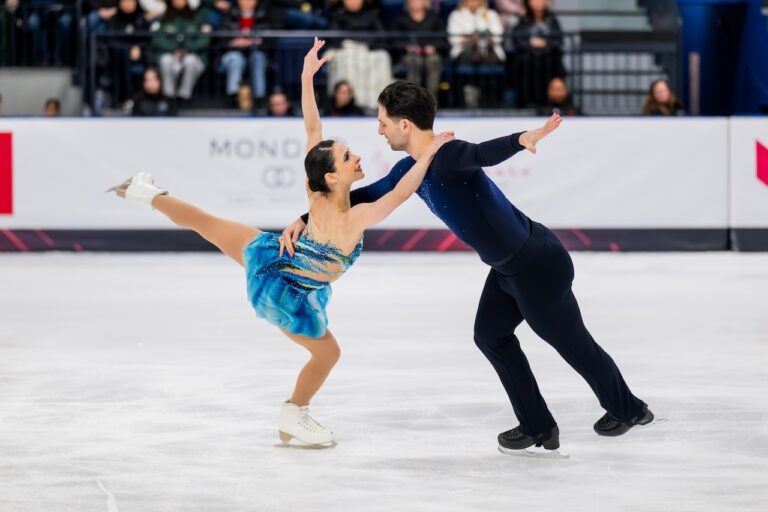
Many thanks to Deanna! We will all be supporting her on her Olympic journey!
Follow Deanna on Instagram: @deannamsd622

Photographs kindly provided by the photographer Danielle Earl: @danielleearlphotography
Se vuoi condividere il tuo pensiero su questo articolo o semplicemente parlare di pattinaggio, il nostro gruppo Telegram è il posto giusto per farlo: pubblichiamo anche tutti gli aggiornamenti per i prossimi camp! Puoi trovare le foto più belle delle nostre attività e i più recenti aggiornamenti sul profilo Instagram.
Lo sapevi che anche tu puoi scrivere sulle pagine del nostro Diario? Mandaci una mail a infoskatingdiaries@gmail.com !